Class session with Year One student. ENJOY WATCHING...!!


Thursday, 8 November 2012

English Year 1 Grammar : Articles
Articles
An article (abbreviated art) is a word (or prefix or suffix) that is with a noun to indicate the type of reference being made by the noun. Articles specify the grammatical definitenessof the noun, in some languages extending to volume or numerical scope.An article is usually considered to be a type of adjective.
Types of articles
Articles are usually characterized as either definite or indefinite. A few languages with well-developed systems of articles may distinguish additional subtypes.
Within each type, languages may have various forms of each article, according to grammatical attributes such as gender, number, or case, or according to adjacent sounds.

Definite article
A definite article indicates that its noun is a particular one (or ones) identifiable to the listener. It may be something that the speaker has already mentioned, or it may be something uniquely specified. The definite article in English, for both singular and plural nouns, is the.
The children know the fastest way home.
The sentence above refers to specific children and a specific way home; it contrasts with the much more general observation that:Children know the fastest way home.
The latter sentence refers to children in general, perhaps all or most of them.
Likewise,
Give me the book.
refers to a specific book whose identity is known or obvious to the listener; as such it has a markedly different meaning from
Give me a book.
which does not specify what book is to be given.
The definite article can also be used in English to indicate a specific class among other classes:
The cabbage white butterfly lays its eggs on members of the Brassica genus.
Indefinite article
For example:
A white house on a green hill.
A cat ate the sardine
* We are not specifying which cat ate the sardine, it could have been any cat.
Notes:
It is normal to use the indefinite article when we mention someone or something for the first time in our conversation or text.
For example:
I've finally got a good job.
We bought a new computer and it was cheap.
Would you like a drink?
"A" and "an" are also used to refer to a particular member of a group or class.
For example:
She is an English teacher.
He wants to be a dancer.
John is an Englishman.
Sherlock Holmes was playing a violin when the visitor arrived.
I was born on a Thursday.
We also use the indefinite article to talk about price / weight, speed.
For example:
This car does 240 km an hour.
It is 10 euros a kilo.
Certain numbers in English require the presence of an indefinite article.
For example:
A hundred, a thousand, a million, etc...
With singular nouns, after the words "what" and "such"
For example:
What a day!
What a shame!
She's such a beautiful girl.
Meaning "one", referring to a single object or person
For example:
I'd like an orange and two lemons please.
The burglar took a diamond necklace and a valuable painting.
The choice between "a" and "an"
Depends on the initial sound of the adjective that immediately follows the article:
Use "a" with nouns starting with a consonant. On the other hand, we use "an" before nouns starting with a vowel.
For example:
an umbrella
a table
an elephant
a book
NOTE: If the next word begins with a consonant sound when we say it then we use a. If the next word begins with a vowel sound when we say it then we use an.
For example:
We say "university" with a "y" sound at the beginning as though it were spelt "youniversity".
=> a university
We say "hour" with a silent h as though it were spelt "our".
=> an hour
Now it's time for exercise.

Here are the sample exercise.
Example 1

Example 2

Example 3

Example 4

Example 5

Until then,
see ya..=)
Sunday, 28 October 2012
Parts of the human body..
Parts of the human body is one of the subtopic in English Year 1 syllabus.
Learning about parts of body could be fun and educational for the kids.

Front parts of the body

Back parts of the body
Here are some of the sample exercises regarding the topic.
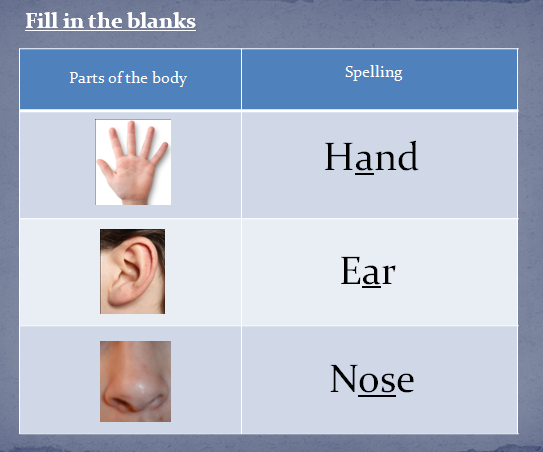
Example 1
Fill in the blanks.
In this activity, the students need to complete the spelling by
fill in the blank with the
correct missing alphabet.

Before
After
Example 2
Fill in the blanks with the correct answers.
In this activity, students have to fill the blanks with the correct answer.
They have to choose the answer among the options given.

Before

After
Example 3
Match the pictures.
Students need to match the picture in the left side to the correct answer
at the right side.

Before

After
After a few exercise. I think we need to relax and have a little fun.
Let's sing a song. Yay!!
Head, Shoulders,Knees and Toes
Head, shoulders, knees and toes,
Knees and toes.
Head, shoulders, knees and toes,
Knees and toes.
And eyes, and ears, and mouth,
And nose.
Head, shoulders, knees and toes,
Knees and toes.
Till then,
See again in next lesson.
Thursday, 25 October 2012
Let's learn about numbers 1 to 10
One little, two little, three little Indians
Four little, five little, six little Indians
Seven little, eight little, nine little Indians
Ten little Indian boys.
Let's learn about Farm Animals
Old MacDonald had a farm,
Ee i ee i oh!
And on that farm he had some chickens,
Ee i ee i oh!
With a cluck-cluck here,
And a cluck-cluck there
Here a cluck, there a cluck,
Everywhere a cluck-cluck
Old MacDonald had a farm
Ee i ee i oh!
Old MacDonald had a farm,
Ee i ee i oh!
And on that farm he had some dogs,
Ee i ee i oh!
With a woof-woof here,
And a woof-woof-woof there
Here a woof, there a woof,
Everywhere a woof-woof
Old MacDonald had a farm
Ee i ee i oh!
Old MacDonald had a farm,
Ee i ee i oh!
And on that farm he had some turkeys,
Ee i ee i oh!
With a gobble-gobble gobble-gobble here,
And a gobble-gobble gobble-gobble there
Here a gobble-gobble, there a gobble-gobble,
Everywhere a gobble-gobble-gobble
Old MacDonald had a farm
Ee i ee i oh!
Old MacDonald had a farm,
Ee i ee i oh!
And on that farm he had some cows,
Ee i ee i oh!
With a moo-moo here,
And a moo-moo there
Here a moo, there a moo,
Everywhere a moo-ooo
Old MacDonald had a farm,
Ee i ee i oh!
Subscribe to:
Posts (Atom)